
Written by
Shwe Maw
Originally from Myanmar. Resides in Kyoto. The compassionate Mother Teresa & poster girl of MADOKA Kyoto Station West. Buddhist. Favorite flower: plum blossoms. Favorite Japanese foods: beef tongue, ajari mochi. Favorite Japanese phrase: “Constant dripping wears away the stone.”
February 8, 2026. On the day a powerful cold wave — one of the strongest this season — hit the Japanese archipelago, bringing record-breaking heavy snowfall and severe cold to many areas, snow also accumulated in Kyoto.
I headed to Kinkaku-ji to see its snowy scenery.
February 8, 2026:
Snow Scene Experience Report
February 8, 2026: Woke up at 7:00 AM. After breakfast and getting dressed, I stepped outside my apartment to find a light dusting of snow on the ground. I felt excited.
Glancing sideways at MADOKA Kyoto Station West, I silently murmured, “I’m off.” I walked to Shichijo Horikawa, boarded City Bus 205, and got off at Kinkakuji-michi. From the bus stop, it took about a 5-minute walk to reach Kinkaku-ji.
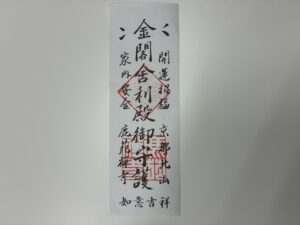
After paying the 500 yen admission fee, instead of a ticket, I received an amulet (ofuda) inscribed with “Kinkaku-ji Shari-den Goshugo” (Guardian of the Golden Pavilion Relic Hall). This seems auspicious. I’ll display it at home.
Stepping into the temple grounds, evergreen trees and large deciduous trees lined both sides of the path, their branches and ground covered in white snow. The soft sunlight filtering through the trees and the powdery snow swirling in the breeze created a scene like a fantasy world.
Advancing a little further, the snow-covered Kinkaku-ji immediately appeared. It was as beautiful as a single masterpiece painting.
The golden hue of Kinkaku-ji, standing by the pond, stood out even more vividly against the silver-white world, radiating a presence like a hidden treasure.
The scene was like a pavilion in the heavens.
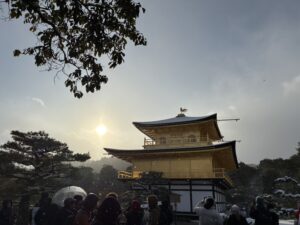
Kinkaku-ji is a globally rare architectural structure, themed around the fusion of aristocratic, samurai, and religious cultures, with each of its first, second, and third floors constructed in distinct architectural styles.
The temple building evokes a sense of solemnity, elegance, and tranquility all at once. The snow-covered Kinkaku-ji seems to amplify these feelings even further.
Visiting the snow-covered Kinkaku-ji became a truly special experience, deeply etched into my heart.
Kinkaku-ji Temple Overview
| Facility Name | Kinkaku-ji Temple |
| Address | 1 Kinkakuji-cho, Kita-ku, Kyoto-shi, Kyoto 603-8361 |
| Phone | 075-461-0013 |
| Hours | 9:00 AM – 5:00 PM |
| Access | From Kyoto Station, take the Kyoto City Bus to “Kinkakuji-michi” stop, then walk 5 minutes. |
| Website | www.shokoku-ji.jp/kinkakuji |
| @rokuonji_kinkakuji.official |
History of Kinkaku-ji Temple
Beginnings — 1397
Ashikaga Yoshimitsu acquired an aristocratic residence and renovated it as his villa, “Kitayama-den.” The garden and architecture centered around the Golden Pavilion are said to represent the Pure Land of the West in this world. The Shari-den embodies the fusion of aristocratic, samurai, and religious cultures, with each of its three stories built in a distinct style. During the era of thriving Japan–Ming China trade, it served as a crucial diplomatic venue for entertaining envoys.
Becoming a Zen Temple — 1408
After Yoshimitsu’s death, it became the Zen temple Rokuon-ji (Rinzai sect) according to his will, continuing as an important site of mourning for Yoshimitsu.
Destruction and Reconstruction — 1950 & 1955
The temple was destroyed by arson committed by a novice monk(monk to be) in 1950, motivated by “jealousy of beauty” and personal resentment. This tragedy later inspired Yukio Mishima’s celebrated novel The Temple of the Golden Pavilion. Detailed blueprints from a major Meiji-period restoration allowed for an extremely faithful reconstruction in 1955.
World Heritage — 1994
Kinkaku-ji Temple was registered as a UNESCO World Heritage Site, cementing its cultural and historical significance both within Japan and internationally as a heritage site deserving of worldwide protection.
3 Tips for Viewing
Kinkaku-ji’s Beautiful Snow Scenery
Check the Live Camera
Monitor the Kinkaku-ji live camera on the official website before heading out. January to February is the prime season — confirm there’s fresh snow before your visit.
Arrive Right at Opening
Aim for the 9:00 AM opening. The key is to capture the contrast of gold and silver shining in the morning eastern light, before the snow melts in the afternoon sun.
Dress for the Cold
Bring thick gloves, hand warmers, insulated boots, and an umbrella to prepare for rapidly changing winter weather in Kyoto.
FinallyIn winter in the ancient capital of Kyoto, shrines and temples blanketed in snow are filled with tranquility and beauty. Among them, Kinkaku-ji Temple — a World Heritage Site shining with particularly dazzling gold — is especially worth visiting.
While photos and videos make wonderful memories, the experience of standing there in person, seeing and feeling it with your own eyes, will become a treasure that stays with you forever.
If you encounter snow in winter Kyoto, please visit Kinkaku-ji and create irreplaceable memories.
Reference Sources